Central London, where I live, is so heavily polluted with artificial light at night that observing most deep sky objects is close to impossible so I leave town for dark sky sites as much as possible. This year I have been to the Isle of Wight Star Party in February, my base in the Canaries in April and each year I attend the biannual AstroCamps held at the Cwmdu campsite in the Brecon Beacons Park. This Spring AstroCamp was held May 09 - 11. A few days before my departure the weather forecasts for the area were not encouraging yet I was not put off as each small valley in the Brecons experiences its own meteorological conditions making for unreliable local forecasts.
Leaving Marylebone on Saturda, the 9th I arrived at my usual accommodation base, the only pub in the small village, the Farmers’ Arms. Quickly dropping off my overnight bag I popped along the lane the ⅓ miles to the campsite. This was the first AstroCamp where all the tent and motorhome pitches were sold out making for a crowded site when I arrived just before 3pm.

photo by Terry Regan
Having ‘pegged my claim’ on the Common with my groundsheet I set up my equipment: for solar observing, my Lunt 60mm single stack with pressure tuner and B1200 blocking filter mounted on my AZ4 Alt-Az mount. This set up is entirely manual: no computer control, no alignment so I was able to set up and observe the chromosphere of the Sun within a few minutes.
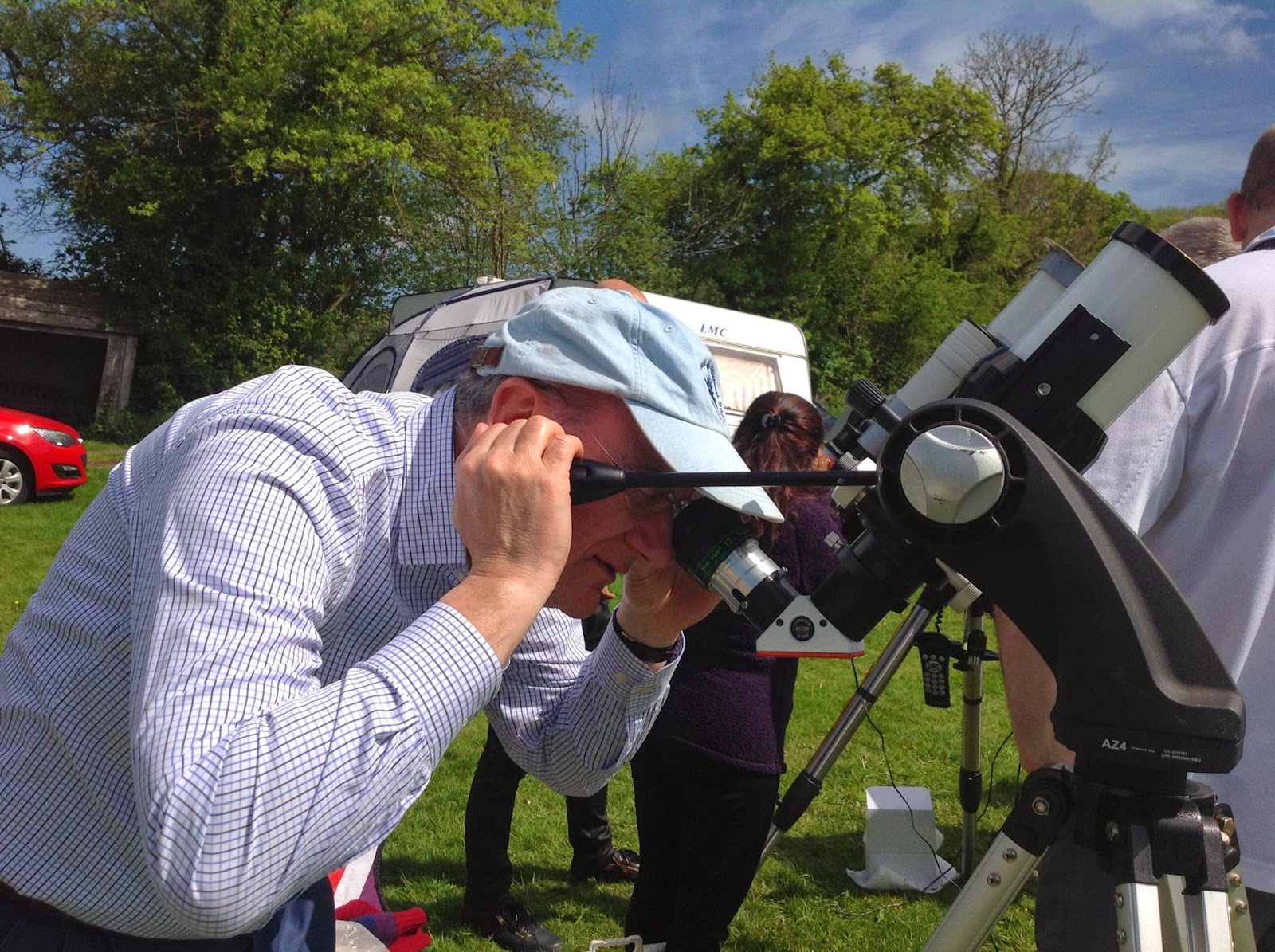
photo by Fawzia Muradali Kane
For the dark nights I had planned to observe a few of the DSOs not visible in central London, particularly galaxies and had my eye on seeing M108, the elliptical galaxy in UMa which I had yet to view. At mag 10.7 it was a possible target at Cwmdu. I brought my trusted 3” refractor, the William Optics GT81, transported snugly in its own rigid backpack. I also set up my cheap SynScan Alt-Az GoTo mount and tripod, too lightweight to carry heavy scopes but sufficient to take the Lunt or GT81 if I wished to track any target.
In the Saturday late afternoon daylight I spent time observing in H-alpha the complex sunspot group making up AR2339. Not the best time of day for solar observing: I prefer the morning when the air is less turbulent. The group was a complex set of spots and observing them proved to be my highlight of the star-party.

Image by Dave Wilkinson
After dinner in the pub I viewed the evening skies: a light haze shrouded Venus and Jupiter as they appeared then only a few small patches of clear areas were spotted. During a frustrating session spent staring at low cloud I did manage to spend three quarters of an hour observing galaxies M81 and M82, globular cluster M92 and Saturn as it rose in the east, yet in the little time available M108 still eluded me. The clouds defeated me: I gave up and covered my scope at 01:30, walked to the pub and was in my room above the pub, my ‘Presidential Suite’, by 02:15.
Each Sunday morning of AstroCamp I host a solar observing and imaging session on the Common, from 10:00 until noon. But looking out of the pub windows while consuming my generous cooked breakfast it was obvious the low grey cloud cover would prevent any solar observing that Sunday. So a gentle walk in neighbouring country lanes was the order of the early morning and I was pleased to be rewarded by hearing the call of a Cwmdu cuckoo. The rest of morning was spent in astro-talk and socialising with old and new AstroCampers. One topic of conversation I introduced was the current UK market for astronomers. How many amateur astronomers buying equipment are in the UK? And how much do they spend on a regular basis?
My neighbours on the Common formed an ad hoc team to compete in the astro-quizzes arranged for that afternoon at the nearby village hall. After much gentle ragging from the quiz organisers we triumphed in the ‘Masters of the Universe’ advanced astro quiz winning a box of bottled of beer. In the late afternoon and evening it was obvious the chances of clear dark skies that night were slim. But I remained on the Common staring at clouds until 01:30 when I repaired to warm bed.
The sun was out on the third morning and good solar observing was had by many on the Common. White filters over objectives, hydrogen alpha Lunt and Coronado ‘scopes and Daystar Quark filters were put to good use to observe and record that interesting multiple sunspot group AR2339. I did witness a degree of flaring at a couple of places between the spots at each side of the group. In addition a prominence on the following solar limb developed beautifully throughout the morning. I did enjoy showing the chromosphere features to those who had never viewed through a H-alpha ‘scope before.

photo by John Liggins
I broke off my viewing for the traditional communal High Tea on the Common which is held at the early time of 2pm. Everyone attends and contributes a little food and drink to this well established AstroCamp event. I quitted observing the Sun soon after the Tea to take exercise walking in Cwmdu lanes as clouds again arrived to ruin prospects of any dark skies on the last night. On the Common we persisted in hoping for gaps in the low clouds to appear but for hours were frustrated: I can claim we present on the Common did see Venus with our unaided eyes. Such was our frustration with the clouds that we cheered whenever the planet popped into view for less than a minute as it set behind the western hills. At midnight I walked back to the pub and my bed.
The arrival of early dew during a night session had been a problem at past AstroCamps. At the previous meeting last September a session under clear night skies had been cut short for me by dripping moisture appearing on the objective, eyepieces and red dot finder of my 81mm refractor. Application of gentle heat from a neighbour’s camping hairdryer only removed the moisture for a short time: the dew quickly reappeared making further observing impossible. This time, in anticipation of Cwmdu dew, I had purchased a Kendrick dew controller and suitable heat band. Not needed at my sessions in the Canaries, the system was to be debuted at AstroCamp yet still unused.
On the Tuesday morning, collecting my kit from the Common, I said my farewells and motored back to Marylebone. I shall return to Cwmdu next September


