2013-10-20

Penumbral Lunar Eclipse 2013 Oct 18.

by Eric Emms

The Flamsteed Astronomy Society had organised a meeting on Blackheath to observe the eclipse and the Sky At Night TV programme  planned to film the event for transmission in early November. Several Baker Street Irregulars,  including me, would be attending.

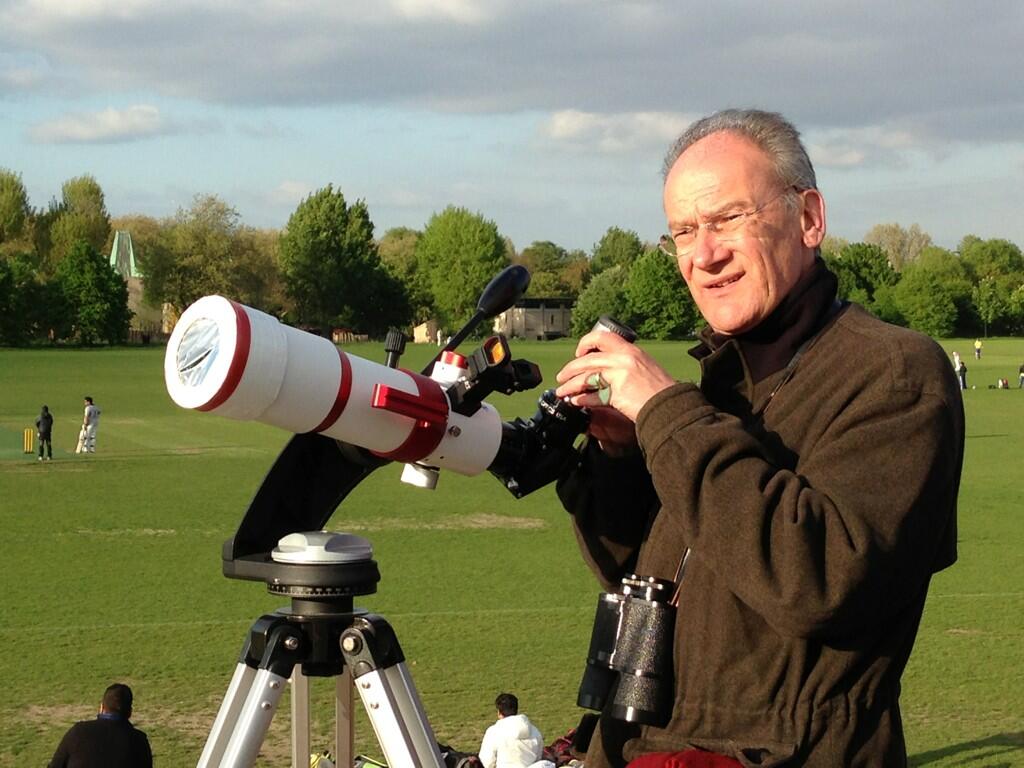
I arrived at the location by car before 19:00 UT to find bright lights from the TV crew illuminating the patch of the heath where an array of telescopes had been set up. In the light it was easy to set up my William Optics GT-81 then ponder the thick clouds masking the Moon.

Photo: Julie Ramsden.

The four-hour eclipse was expected to be at its maximum at 23:51 UT so all had time to chat with the Flamsteed astros, Irregulars and curious locals who turned up to see the event.

Photo: Philip Stobbart

We waited for the clouds to part. We waited. The TV hosts went through their routines to camera. We waited. Lunar and asteroid belt meteorites were thoughtfully shown to us by planetary scientist Katie Joy 

Photo: Philip Stobbart

Then we waited and chatted. And we chatted and waited. The Moon poked through the clouds on occasions allowing me to show the disc to a few young people but soon retreated behind cloud cover.

As the hours of the eclipse wore on there was little chance of observing any of it. The astronomer numbers were draining away: I packed up, thanked the Flamsteed organisers, trudged to my car and headed home.

2013-10-16

I Have Never Seen Mercury


Since I’ve taken up stargazing again in 2010 the opportunity to see Mercury, that sun-hugging innermost planet, has never arose. In other words I have never seen Mercury, truly a confession any stargazer should be ashamed of.

My Central London observing site (my terrace at my home) provides a good Eastern facing aspect but objects low in the Western sky are obscured by houses. Mercury and other planets close to the setting sun are beyond my reach.

The triple conjunction of Jupiter, Venus and Mercury in late May 2013, when all three planets were within 5 degrees of each other soon after sunset, provoked me to attempt to see Mercury for the first time.


Credit: Chris Schur.

Could I find a near-by site to view a western horizon within Central London with my telescope? No. And as I didn’t wish to travel outside town I decided to go Mercury hunting in London street armed with my binoculars, an old East German Carl Zeiss 10x50 pair.

On the evening of the 27th May I walked to a suitable vantage spot in a Central London street and waited on a pavement for dusk and the appearance of the triplet. The spot turned out not to be sufficiently suitable: no planets were seen, buildings still hindered my view. I tried again the following evening in another street – another failure. There are too many buildings in London. I did succeed in receiving suspicious glances from passers-by who must have wondered why I was peering through binoculars, one community support office (a traffic warden) ending his shift engaged me in conversation demanding to know what I was up to.

Mercury had to wait until my first 2013 trip to the Canaries planned for June. Meanwhile I resolved never to attempt again on-street observing.


2013-07-02

Solar observing at AstroPicnic 2013

The idea for a day of observing the Sun through solar filters and having a picnic arose from a discussion I had in May with Fawzia Muradali Kane, a fellow Irregular of the Baker Street Astronomers.

I decided that the best date for the first of its kind would be Sunday 30th June. Floating the suggestion on various social media gathered a sufficient positive response so all was set. We just needed clear skies and a suitable site. Following our tradition of meeting in Regent’s Park for our regular BSIA events it seemed natural to hold the solar viewing with the park. It was suggested that close to the amenities around Hanover Gate would be the best location.

The day before the event I had my last recce of the spot; it looked quite deserted at noon and offering ample opportunity to track the sun as it moved across the sky from morning to late afternoon. No trees would impede any observation.

The weather for the planned day looked promising: warm temperatures with light variable clouds and at 09:30 on the Sunday I picked up my kit and walked from home to Hanover Gate, Regent’s Park and was delighted to find the spot was deserted. 


I set up my 81 mm refractor with its Baader solar film filter on its dew shield and being obvious in an otherwise deserted field soon attracted the curious attention of early morning dog walkers, joggers and the regular patrol of an armed policeman. I began observing at 24x three obvious active regions; AR11777, 1778, and 1781.

Soon other Irregulars joined me, pitching their dedicated hydrogen-alpha Lunt solar ‘scopes, telescopes sporting white light solar filters and tripod mounted binoculars. Pretty quickly a score of us were observing our closest star and showing interested passers-by their first view of sunspots.


The day progressed by comparing the view seen through the two Lunt solar scopes kindly brought my Chris and Simon with those seen through white light solar filters, chatting to friends old and new about astro and non-astro subjects; snacking on our picnic victuals.Through the H-alpha filters of the Lunts we saw spectacular examples of prominences, filaments and plages


The temperatures soared to 26°C tempting many to the park so by 3pm we were surrounded by a collection of picnickers, sunbathers, footballers determined to strike a telescope with a ball, energetic young children running around and one kite-flier, so it was time to declare the day a success, break down our equipment pack up our bags and head home.

My thanks go to all who attended particularly those who brought the scopes and binoculars. We shall return for another AstroPicnic in Regent's Park next Summer.


2013-05-24


AstroCamp May 2013.


This was the second AstroCamp at Cwmdu campsite in the Brecon Beacons organised by the Baker Street Irregular Astronomers and as the skies and weather were superb for the first event in Sep 2012 I was keen to attend the latest one. I prefer observing with my eyeballs to imaging so I brought along a ‘shopping list’ of DSO targets to observe over the long week-end. I booked an off-site ticket as soon as the event was organised; I do not camp so, as before, I reserved a room at the local pub, The Farmers Arms.

Friday, 3rd May.


I, with two other Irregulars car sharing, arrived following a four-hour car trip from Marylebone, to find the campsite filling with Astros and their kit expectant of fine clear night-time skies. There was time in the afternoon to set up the WO GT-81 on the AZ4
and contemplate some sunspot viewing using my hand made solar film filter. Less than a minute of viewing elapsed before the clouds enveloped the Sun to remain all evening and night.


Saturday, 4th May.

It had rained during the night and the morning was grey and damp. But there was soon time for some morning solar viewing as the skies cleared.

pic fom Spaceweather.com
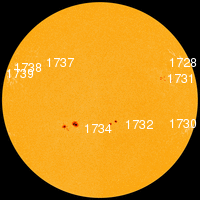
Active regions 11728 to 11739 were observed through a Baader Astro SolarFilm filter at x48 (20mm Vixen NLV EP in a Celestron 2x Barlow).  AR11734 displayed an interesting cat’s paw shape.


At 3pm it was time for the Astro Pub Quiz in the pub where my current lack of astronomical knowledge was demonstrated once again! By 6pm we were back in the camp field viewing Jupiter in the western blue skies until Saturn rose in the East. After observing the two planets easily seen from home in Marylebone I was keen to view a celestial object not visible in the light polluted skies of Central London.  For 2.5 hrs I observed a longed for target: the Leo Triplet.
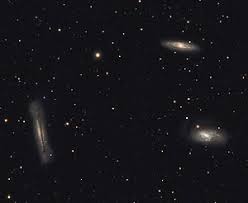
Leo Triplet - pic from Wikipedia
 I’ve never observed them from London so I was determined to enjoy them in the dark skies of the Brecon Beacons. M65 and M66 were delightful fuzzy ovals but NGC 3628 eluded my eyes.  By 11:30 clouds had arrived and so to bed satisfied with observing two Messiers unseen by me before.


Sunday, 5th May.

The skies were extremely clear as my evening observing session started at 21:30 UT. I started on my list of DSOs I can’t see from Central London. First up was M51, the Whirlpool Galaxy.
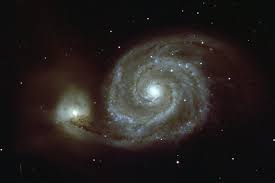
M51 - pic from NASA

I located it using my manual setting circles on my AZ4 mount from co-ordinates provided on my SkiSafari Pro app. At x24 I could detect a rounded even silvery shape – of course nothing like the detail seen in the image. I was pleased the evening started successfully.


22:09 UT - Next up was the Bodes galaxies, M81 and M82. Again I’ve tried several times unsuccessfully to discern these in London and was excited when both hove into view appearing as milky ovals at 24x.

M81 and M82. Image from astrobin.com


21:32 UT – many fellow Astros were enjoying the Great Globular Cluster in Hercules, M13, so I joined in with the excitement and pointed the GT-81 at it and was pleased with the far greater detail than when viewed from NW1.
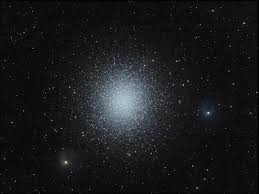
M13. Image by NASA


21:43 UT – I returned my attention and scope toward the Leo Triplet. As during the previous evening not all three were observed at x24 but the two Messiers: M65 and M66. The faintest NGC 3628 was again a ‘no show’ to my curious eyes. The two oval smudges were a delight to register. I felt my trip to the dark sky site had been worthwhile just to see these.

Finally I returned to globular clusters and spent time enjoying M53 at x24.
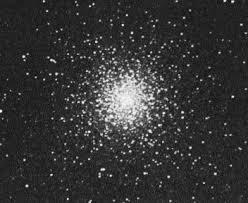
M53 pic from messier.seds.org


I was pretty tired by 21:45 UT so decided to relax in one of my astro-chairs with my 10x50 binoculars scanning the Realm of Galaxies in Virgo. Dew arrived presently on oculars and objectives hampering further observing by telescopes and I called it a night just before midnight.

Conclusion.

I went to Brecon Beacons for the dark skies, to observe DSOs I cannot detect from Central London. I was delighted and excited to see all I wanted to see in the skies. My experience has whetted my appetite for the Canary Islands skies I shall be under in early June.


2013-05-23

Baker Street Irregulars Astronomers - May 20133 Meeting

Photo by @jimanning. 

By Eric Emms.

For this month's meeting I wanted to view the triple planetary near-grouping of Jupiter, Venus and, the planet I've yet to observe, Mercury. 
The trio were to be seen low in the north-west soon after sunset due at 19:56 UT. (8.56 pm BST). I arrived at the Hub, Regent's Park earlier than sunset so spent time observing and showing to others sunspot activity using my solar film filter.

The Moon, waxing gibbous, 9/10th illuminated, soon revealed itself from behind light cloud in the East and as the Sun became obscured by the trees of the park I showed the Moon to a few first-time visitors to our group. Against a bright sky little definition of the lunar surface could be made out at that early part of the evening.

Soon I spied Jupiter through my 10x50 binoculars, bright but very low in the north-east. Through my WO GT-81 at 48x the planet showed as a small bright disc although no Galilean moons were detected. Both Venus and Mercury escaped my scrutiny and Jupiter, now eye-visible, soon sank below the tree-line. A few first-timers at the Hub observed Jove for the first time: not its best display, of course, but Saturn awaited.

Turning to the east, my binoculars again helped as I located Saturn in a still blue sky, a few degrees left of the brightening Moon. Seeing conditions suffered during the evening: poorly defined cloud belts on the disc could be glimpsed but satellites weren't seen. The rings, as always, delighted those present who observed at 48x and 224x.
All other photos by @PhilipStobbart


I returned to showing to others the bright Moon


But it was now so dazzling observing at the eyepiece had become painful on the eye. I didn’t bother to crack open by variable polarizing filter so I decided to try something new. I projected the Moon's image from the eyepiece on to paper to the delight of all around.


As the stars finally made their appearance I turned my scope toward the zenith 


to show the multiple stars of the binary Mizar and Alcor.

Finally I awaited the appearance of a bright Iridium flare in Leo before heading home.

2013-04-07

Hampstead Observatory

Saturday 6th April 2013.

To Hampstead and my first visit to its observatory. Belonging to Hampstead Scientific Society this site is open to the public on clear weekend nights from September to April. I, like many London amateur astronomers, have heard of the observatory through being featured in a past Sky At Night programme. The recent poor weather having abated and clear skies likely on the Saturday evening I ventured north a short distance to the observatory.

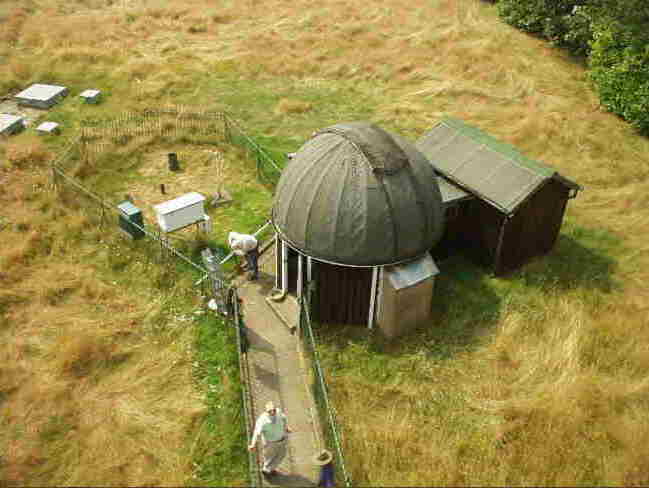
It's a building looking like what an observatory should be! - a dome with a shed attached.


Its history is recounted on the Society's website.

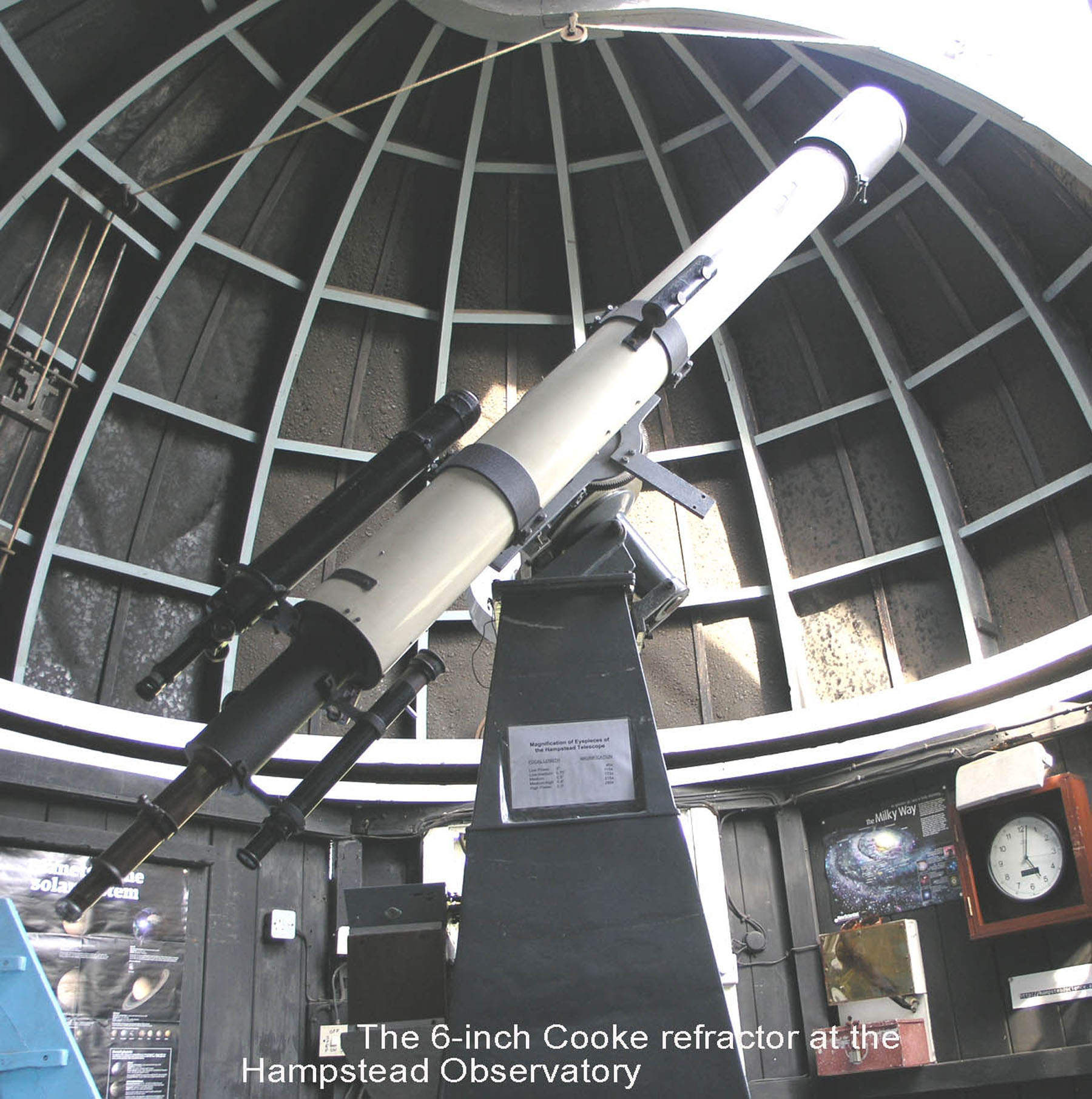
I arrived at the appointed time of 20:00 and was lead into the dome by its volunteers. Inside the 6" Cooke refractor resides: a Late Victorian model given to the Society in the 1920s.


Its equatorial mount and concrete pilar was renovated in the the 1970s, upgraded to a infra-red controlled clock motor. The fabric of the dome roof has been replaced recently at a cost of £5000 paid for by subscription.

Douglas Daniels, the president of the Society, fired up the Cooke to show me a view of Jupiter, Io and Europa through low and medium magnification. Perhaps forty other visitors, young and old, were able to use the Cooke within the hour; Douglas was assisted well by the help of two other keen volunteers. It is important to know the observatory thrives through the work of volunteers without any external funding.

My evening in Hampstead concluded with a short stroll to edge of the Heath to observe comet PanSTARRS through a 6" Schmidt-Cassegrain. The celestial visitor appeared much dimmer and less defined than when I first saw it on 13th March at Regent's Park.

I recommend any London-based astro who has not done so to visit the Hampstead Observatory.

2013-03-27

APM-LZOS 100/800 refractor

So I bought another refractor. Why?

The idea is to keep my William Optics GT-81 in London for fun grab'n'go observing in the UK and have a larger scope for serious use on the volcano in the Canaries. OK there may be a little aperture fever involved in the decision. I wanted more objective size with the best glass and a Feather Touch focuser. Research led me to the Russian optics and the APM brand.

I decided on this 100mm and ordered it directly from the manufacturer in Germany for delivery to the Canaries.

Yesterday the package was delivered. It's in the Canaries and I'm still in London...