2013-05-24


AstroCamp May 2013.


This was the second AstroCamp at Cwmdu campsite in the Brecon Beacons organised by the Baker Street Irregular Astronomers and as the skies and weather were superb for the first event in Sep 2012 I was keen to attend the latest one. I prefer observing with my eyeballs to imaging so I brought along a ‘shopping list’ of DSO targets to observe over the long week-end. I booked an off-site ticket as soon as the event was organised; I do not camp so, as before, I reserved a room at the local pub, The Farmers Arms.

Friday, 3rd May.


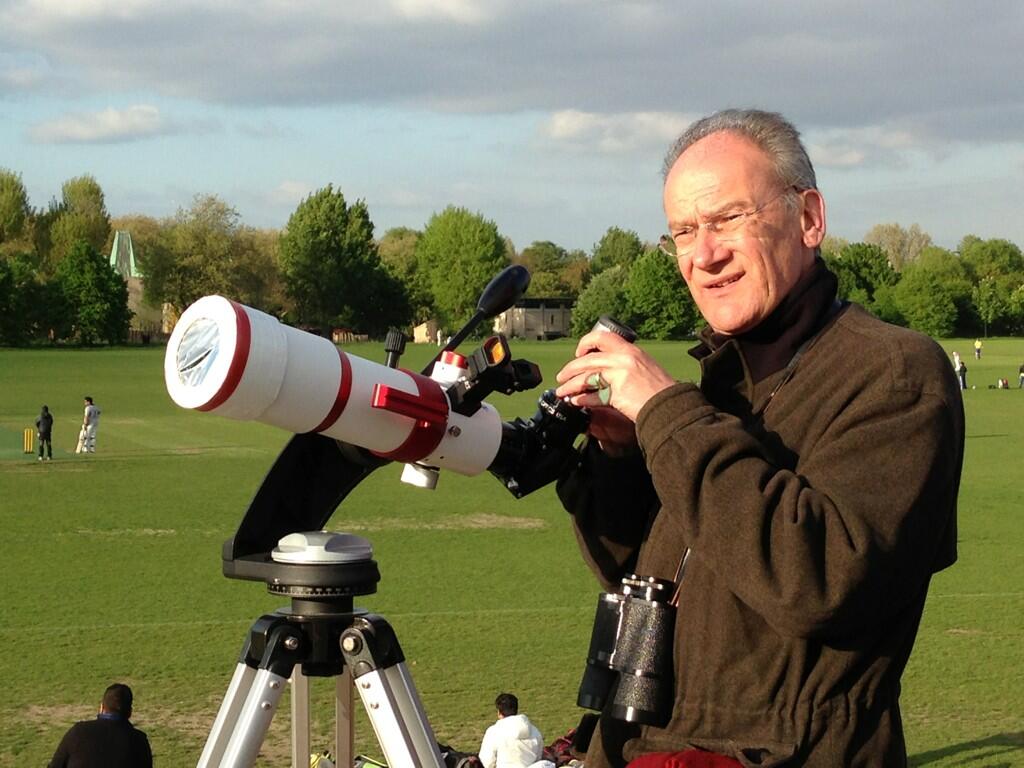
I, with two other Irregulars car sharing, arrived following a four-hour car trip from Marylebone, to find the campsite filling with Astros and their kit expectant of fine clear night-time skies. There was time in the afternoon to set up the WO GT-81 on the AZ4
and contemplate some sunspot viewing using my hand made solar film filter. Less than a minute of viewing elapsed before the clouds enveloped the Sun to remain all evening and night.


Saturday, 4th May.

It had rained during the night and the morning was grey and damp. But there was soon time for some morning solar viewing as the skies cleared.
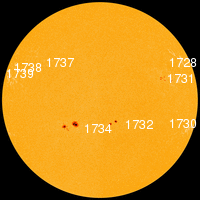
pic fom Spaceweather.com
Active regions 11728 to 11739 were observed through a Baader Astro SolarFilm filter at x48 (20mm Vixen NLV EP in a Celestron 2x Barlow).  AR11734 displayed an interesting cat’s paw shape.


At 3pm it was time for the Astro Pub Quiz in the pub where my current lack of astronomical knowledge was demonstrated once again! By 6pm we were back in the camp field viewing Jupiter in the western blue skies until Saturn rose in the East. After observing the two planets easily seen from home in Marylebone I was keen to view a celestial object not visible in the light polluted skies of Central London.  For 2.5 hrs I observed a longed for target: the Leo Triplet.
Leo Triplet - pic from Wikipedia
 I’ve never observed them from London so I was determined to enjoy them in the dark skies of the Brecon Beacons. M65 and M66 were delightful fuzzy ovals but NGC 3628 eluded my eyes.  By 11:30 clouds had arrived and so to bed satisfied with observing two Messiers unseen by me before.


Sunday, 5th May.

The skies were extremely clear as my evening observing session started at 21:30 UT. I started on my list of DSOs I can’t see from Central London. First up was M51, the Whirlpool Galaxy.

M51 - pic from NASA

I located it using my manual setting circles on my AZ4 mount from co-ordinates provided on my SkiSafari Pro app. At x24 I could detect a rounded even silvery shape – of course nothing like the detail seen in the image. I was pleased the evening started successfully.


22:09 UT - Next up was the Bodes galaxies, M81 and M82. Again I’ve tried several times unsuccessfully to discern these in London and was excited when both hove into view appearing as milky ovals at 24x.

M81 and M82. Image from astrobin.com


21:32 UT – many fellow Astros were enjoying the Great Globular Cluster in Hercules, M13, so I joined in with the excitement and pointed the GT-81 at it and was pleased with the far greater detail than when viewed from NW1.

M13. Image by NASA


21:43 UT – I returned my attention and scope toward the Leo Triplet. As during the previous evening not all three were observed at x24 but the two Messiers: M65 and M66. The faintest NGC 3628 was again a ‘no show’ to my curious eyes. The two oval smudges were a delight to register. I felt my trip to the dark sky site had been worthwhile just to see these.

Finally I returned to globular clusters and spent time enjoying M53 at x24.

M53 pic from messier.seds.org


I was pretty tired by 21:45 UT so decided to relax in one of my astro-chairs with my 10x50 binoculars scanning the Realm of Galaxies in Virgo. Dew arrived presently on oculars and objectives hampering further observing by telescopes and I called it a night just before midnight.

Conclusion.

I went to Brecon Beacons for the dark skies, to observe DSOs I cannot detect from Central London. I was delighted and excited to see all I wanted to see in the skies. My experience has whetted my appetite for the Canary Islands skies I shall be under in early June.


2013-05-23

Baker Street Irregulars Astronomers - May 20133 Meeting

Photo by @jimanning. 

By Eric Emms.

For this month's meeting I wanted to view the triple planetary near-grouping of Jupiter, Venus and, the planet I've yet to observe, Mercury. 
The trio were to be seen low in the north-west soon after sunset due at 19:56 UT. (8.56 pm BST). I arrived at the Hub, Regent's Park earlier than sunset so spent time observing and showing to others sunspot activity using my solar film filter.

The Moon, waxing gibbous, 9/10th illuminated, soon revealed itself from behind light cloud in the East and as the Sun became obscured by the trees of the park I showed the Moon to a few first-time visitors to our group. Against a bright sky little definition of the lunar surface could be made out at that early part of the evening.

Soon I spied Jupiter through my 10x50 binoculars, bright but very low in the north-east. Through my WO GT-81 at 48x the planet showed as a small bright disc although no Galilean moons were detected. Both Venus and Mercury escaped my scrutiny and Jupiter, now eye-visible, soon sank below the tree-line. A few first-timers at the Hub observed Jove for the first time: not its best display, of course, but Saturn awaited.

Turning to the east, my binoculars again helped as I located Saturn in a still blue sky, a few degrees left of the brightening Moon. Seeing conditions suffered during the evening: poorly defined cloud belts on the disc could be glimpsed but satellites weren't seen. The rings, as always, delighted those present who observed at 48x and 224x.
All other photos by @PhilipStobbart


I returned to showing to others the bright Moon


But it was now so dazzling observing at the eyepiece had become painful on the eye. I didn’t bother to crack open by variable polarizing filter so I decided to try something new. I projected the Moon's image from the eyepiece on to paper to the delight of all around.


As the stars finally made their appearance I turned my scope toward the zenith 


to show the multiple stars of the binary Mizar and Alcor.

Finally I awaited the appearance of a bright Iridium flare in Leo before heading home.

2013-04-07

Hampstead Observatory

Saturday 6th April 2013.

To Hampstead and my first visit to its observatory. Belonging to Hampstead Scientific Society this site is open to the public on clear weekend nights from September to April. I, like many London amateur astronomers, have heard of the observatory through being featured in a past Sky At Night programme. The recent poor weather having abated and clear skies likely on the Saturday evening I ventured north a short distance to the observatory.

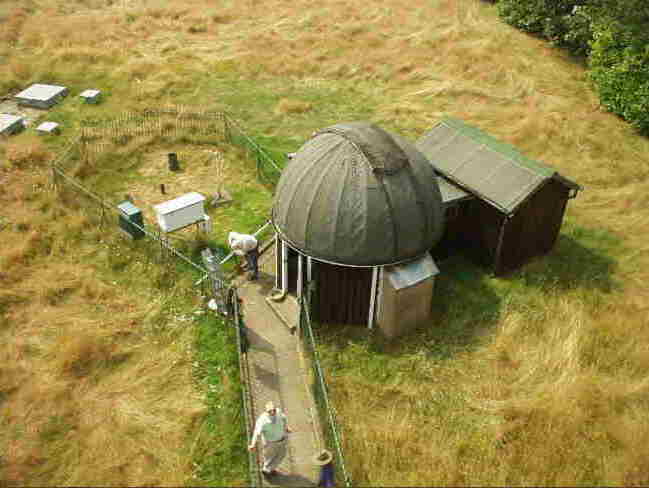
It's a building looking like what an observatory should be! - a dome with a shed attached.


Its history is recounted on the Society's website.

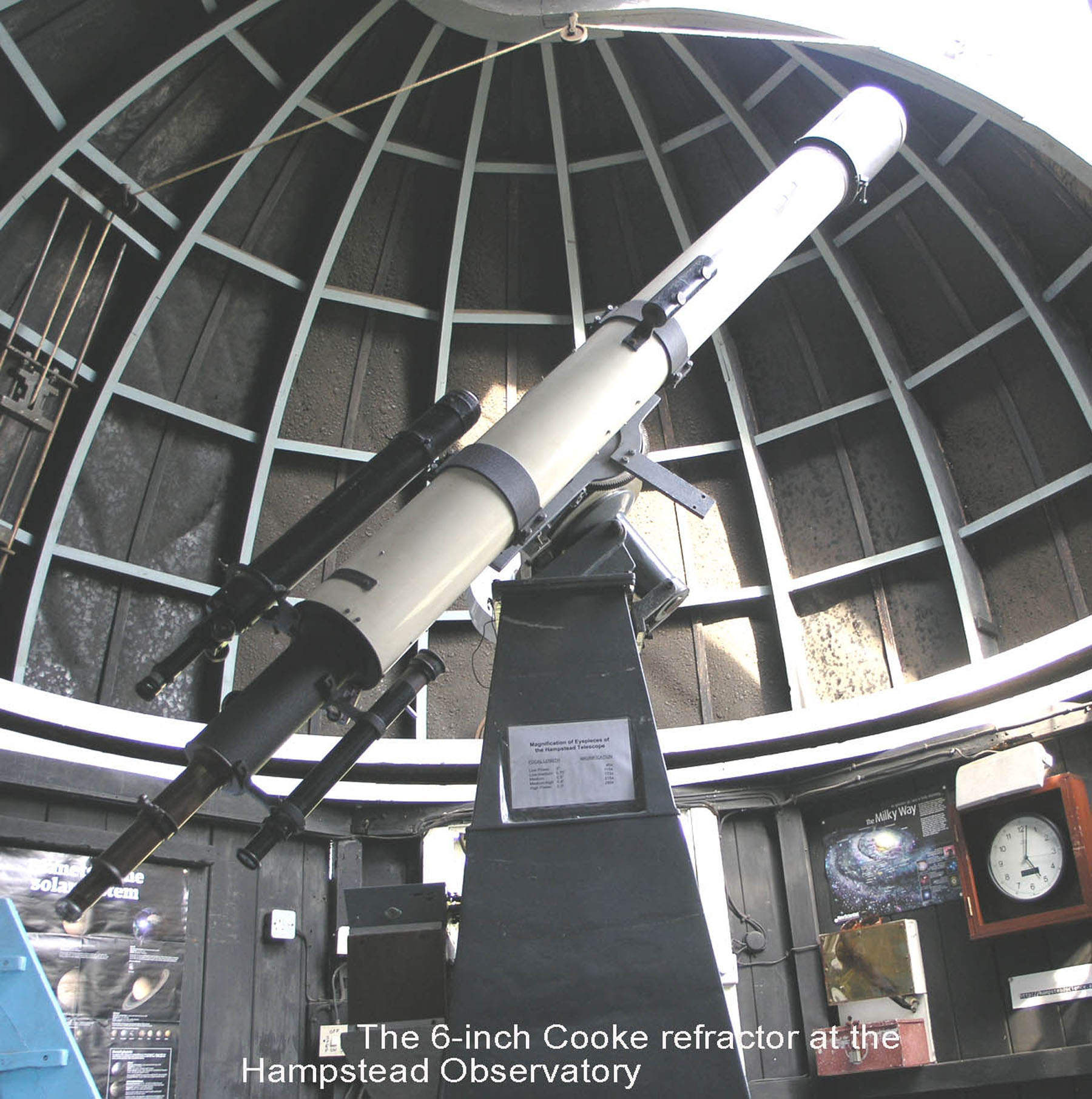
I arrived at the appointed time of 20:00 and was lead into the dome by its volunteers. Inside the 6" Cooke refractor resides: a Late Victorian model given to the Society in the 1920s.


Its equatorial mount and concrete pilar was renovated in the the 1970s, upgraded to a infra-red controlled clock motor. The fabric of the dome roof has been replaced recently at a cost of £5000 paid for by subscription.

Douglas Daniels, the president of the Society, fired up the Cooke to show me a view of Jupiter, Io and Europa through low and medium magnification. Perhaps forty other visitors, young and old, were able to use the Cooke within the hour; Douglas was assisted well by the help of two other keen volunteers. It is important to know the observatory thrives through the work of volunteers without any external funding.

My evening in Hampstead concluded with a short stroll to edge of the Heath to observe comet PanSTARRS through a 6" Schmidt-Cassegrain. The celestial visitor appeared much dimmer and less defined than when I first saw it on 13th March at Regent's Park.

I recommend any London-based astro who has not done so to visit the Hampstead Observatory.

2013-03-27

APM-LZOS 100/800 refractor

So I bought another refractor. Why?

The idea is to keep my William Optics GT-81 in London for fun grab'n'go observing in the UK and have a larger scope for serious use on the volcano in the Canaries. OK there may be a little aperture fever involved in the decision. I wanted more objective size with the best glass and a Feather Touch focuser. Research led me to the Russian optics and the APM brand.

I decided on this 100mm and ordered it directly from the manufacturer in Germany for delivery to the Canaries.

Yesterday the package was delivered. It's in the Canaries and I'm still in London...

2013-03-15

Comet C/2011 L4 PanSTARRS

The last comet I saw was Hale-Bopp back in April 1997, in Basel, Switzerland. I was on a business trip and remember seeing it with my naked eyes as I walked out of a restaurant. Astronomy did not figure much as a hobby back then - no binoculars accompanied me.

2013 - now the possibility of at least two comets this year and I have the bins (old East German Zeiss 10x50) and 'scope with which to bag them - comets and weather permitting.

On Wed 13th March we Baker Street Irregulars convened for our regular monthly meeting in Regent's Park. The weather had been very changeable: bright sunny spells then drizzle then sunshine then hail then snow, all within an hour. Regardless the intrepid cohort of Irregulars were ready at the Hub at sunset for a chance to view PanSTARRS low in the west.

The Moon, showing a fine display of Earthshine and a lower bright thin crescent, was doing its best to poke through grey drifting clouds as the western skies darkened and at 18:45 we saw the comet.

Half-way between the Moon and the point on the horizon where the Sun had set, I spotted through the binoculars a rounded patch, much brighter than I had expected with a short, more diffused tail, looking like a pigeon's tail in shape! We spied the comet until it disappeared towards the horizon; some Irregulars having captured the scene on camera.
Photo by Philip Stobbart.
After the excitement was over we set up our 'scopes to view and show to new attendees Jupiter, Orion, open clusters and double stars in reasonably clear skies although the seeing was not good. Towards the end of the evening I observed Saturn at x80 just as it was rising close by the Euston Tower: my scope practically horizontal.

I have to say I observed more at the Hub and for longer than during the entirity of the IoW Star Party!

2013-03-13

Isle of Wight Star Party 2013

This year I decided to attend the Isle of Wight Star Party for the first time. Observing the heavens through C. London light polluted skies is difficult. Nearly all nebulae and galaxies are impossible to resolve through the city night air so I particularly keen to see as many of these DSOs as possible from the Island dark site.

Wed 6th March
Arrived on the Island on Wed afternoon after an hour's delay at Southampton ferry terminal awaiting frogman check of the ferry's propeller! All was well and arrived on Island to full cloudy sky and a little showers.Weather forecasts not great for the duration of the Star Party. Time will tell.

Thurs. 7th March
Awoke from my base in Cowes to grey skies and little drizzle. Local weather forecast for next 48 hours is 100% cloud cover.Sun sets at 18:00. Checked in with the organisers at the site in the afternoon and pitched up later after sunset in the hope of perhaps a little observing despite the gloomy weather forecast and the leaden skies.

I had a little time to introduce myself to a few of my fellow attendees, the majority of whom had travelled from the mainland to the island. This year was the first time I attended the event and I was pleased to learn a hundred astronomers had booked.

The clouds were working hard to obscure the skies so we repaired to the common room of the camping site to hear a couple of illustrated talks. The first was from Clare who showed pics of her Feb 2012 trip to see the aurora and geological features in Iceland. And David spoke of his participation in the successful attempt to create the largest mosaic photo of the Moon by a team of experienced UK astro-imagers. As David finished his talk he were informed the skies had cleared and stars were apparent! Cue a rush from the room's exit to view the heavens.

I quickly set up the WO GT-81 on the AZ4 and was soon observing old favourites, such as the Pleiades, the Beehive and the Double Cluster and was delighted the darker background of the clusters  made for a far more impressive spectacle than when seen in London skies. However hunting for nebulae and galaxies was thwarted by the enveloping clouds and a little drizzle put paid to the session at approx. midnight. Considering I had not expected any viewing time I was delighted with the first day.

Fri 8th March.
Again a grey mist greeted me in the morning and did not lift all day. I arrived at the Camp as the on-site astronomers were finishing their supper and it was obvious to all that no or very little observing time would be forthcoming. So we decided to have an educational evening in the common room; to begin a Q&A session when I asked about the timing of the Star Party (owners of the campsite returning from holiday, scheduling outside school holidays and the New Moon decided the dates). The pros and cons of the best and worst astronomical accessories were discussed.After a short coffee break various imagers explained the use of their favourite software programs.

The occluded skies being unchanging made for an early exit from the site with a hope for clearer skies over the weekend.

Sat 9th March.
Sunshine breaking through early mist raised my spirits as I arose. Driving to the camp through sun-light verdant countryside maintained my delight: perhaps this weather may hold and patience would be rewarded with clear nocturnal skies.

My WO GT-81 on AZ4 with the AstroChair
At the Camp a few found a little time for solar observing and later I set up my scope in the 'Dob park', an area set aside for visual observing, well away from the astro-imagers, for a bout of 'show and tell'

The sunshine was welcome as we whiled away the time with astro-chat, browsing astro-jumble and observing a kestrel perched on the top of a nearby telegraph pole. But the grey skies soon returned and the mists rolled in to the park extinguishing any hope of observing that night.


Sun 10th March
The weather deteriorated. Grey skies and strong gusts of wind. What some call 'bracing'. Satellite images made for glum viewing then it started drizzling: all before lunch. I arrived at the camp late afternoon with no expectation of observing that night. Some had admitted defeat and quited the Camp in the morning. We whiled the time in astrochat over hot drinks until the time came to leave for dinner in a nearby village pub as the snow fell which for me was the finale for IoW AstroCamp 2013.

Summary
In the four nights scheduled for stargazing the appalling weather allowed for less than one hour observing. So will I return in 2014? Absolutely, in the hope of better weather and clearer skies.
My thanks go to Stephen, Bill and Gill, organisers of the event. 


2013-02-24

Aperture Fever - best avoided.


I blame star-parties for this affliction. TheBaker Street IrregularAstronomers meet each month in Regent’s Park to stare up at low cloud cover or light-polluted skies. No, that’s not fair comment; clear skies do present themselves in which a surprising amount of celestial objects are observable, bringing delight to all who attend the star-party.

I first attended the Hub, the BSIA’s meeting spot in the park, in the Autumn of 2010 soon after the group was established. Without a telescope, just a remembered boyhood love of astronomy instilled by Patrick Moore’s commentaries on the Apollo missions, I pitched up to an early meeting. Soon I was fascinated with the various telescope types members had brought along and the varied views each ‘scope provided. I remember particularly being shown by one of the founders of BSIA my first view of the double star, Albireo, now my favourite binary (thanks Ralph). As a gemmologist who looks at gem colour for a living, I observed a beautiful image of turquoise blue and topaz yellow through the eyepiece. The eyepiece was at the end of a William Optics GT-81. I succumbed to the first symptom of fever: I HAD to buy this telescope!

William Optics GT-81

This refractor was manufactured by William Optics, for some reason, as a limited run of 100: a ‘limited edition’.  I managed to secure number 35 (as attested on the base plate of the focuser) when spending time in the Canaries. On the island I mount it on an HEQ5Pro to enjoy the exceptional skies above the cloud level. 
During first set-up on the HEQ5Pro before ascent to 2300m
Easily transportable in its well designed back-pack, the OTA makes regular appearances at the Hub and the Cwmdu AstroCamp aboard a light, manual alt-az mount, a Sky-Watcher AZ4. This combination of scope and tripod is perfect for quick grab’n’go observing in central London: at the Hub I can set-up in minutes and be observing and showing observing targets to others while other star-gazers are still star aligning and perhaps cursing at their GOTO computers.
Set up  on the AZ4 at the Hub before night falls.
But that aperture fever takes hold of a weak soul. Soon or later one yearns for a something better, bigger and more expensive. There is no antidote: one simply MUST buy something else. Being in close contact at star-parties with other ‘scopes is, of course, the reason why this fever spreads indiscriminately, affecting young and old, the tyro and the ‘old hand’. At one Hub meeting when we were enjoyed exceptional skies a fellow Irregular showed me the double cluster  through his APM refractor (thanks Mathew). It reminded me of two groups of diamond melee scattered on a black gem cloth! So beautiful and all from light polluted Central London skies. I HAD to buy an APM refractor!

After my disappointment with the performance of the Crawford focuser on the GT-81 forcing me to replace it with a WO rack & pinion I vowed my next ‘scope shall have the well respected Feather Touch focuser. I love the optics of the GT-81 but its original focuser did let the scope down and I notice the latest WO scopes have R&P focusers as standard. APM provides the option for a Feather Touch focuser. And now I have learnt about the Russian glass used for the optics in many APM scopes.  This glass is considered by many users to be better than the Japanese glass found in most apo-refractors.
APM Apo-refractor
So the decision has been made: not by my cool head but by the aperture fever burning within. I shall order an APM 100mm apo-refractor. The WO GT-81 will be my UK scope and the APM my Canaries scope. And damn the expense!