2016-10-30

Science In Space with Tim Peake and Tim Kopra

pic UK Space Agency

By Eric Emms

Few reading this blog would not have heard of Tim Peake's six month mission aboard the International Space Station. Following his return to Earth in June Tim has been speaking of his time in Space.

The event I attended on 19 October was the last one of eleven held in the UK on five consecutive days taking in eight UK cities organised by the UK Space Agency and the European Space Agency and billed as Science In Space with the first British ESA astronaut Tim Peake and NASA's Tim Kopra.

Held at the Royal Albert Hall to a full capacity audience of 5,000 the evening was divided into two parts; to begin both astronauts, in conversation with the television presenter Dallas Campbell, spoke of their experiences aboard Expedition 46/47 of the ISS. An half-hour Q&A session followed with audience members, notably many were excited children, queueing to ask their questions.

Both Tims explained the objectives of their mission; of the space station acting as a laboratory where in near zero gravity experiments are conducted measuring the physiological and psychological changes to humans during months away from Earth and observing effects on material and plant specimens. Such knowledge is needed when humans embark on future journeys to Mars. Also on stage was Bridget, the UK-built Mars rover that Tim Peake controlled remotely from the ISS as part of preparations for human-robotic missions to other worlds.

One of the principal aims of Tim Peake’s time aboard devised by the U.K. Space Agency was to engage and enthuse schoolchildren about science and promote of study of STEM subjects. Many of his experiments and activities when aboard involved the participation of youngsters back in the UK.

Peake spoke of his loss of bone density and body-weight, the 'ageing' of his cardiovascular system, skin and eyesight and the weakening of his muscles during his sojourn but regained following weeks back on Earth. I particularly enjoyed descriptions of how they both felt during their joint space walk and of their bumpy ride back to Earth.

Peake and Kopra both spoke in an engaging way which clearly stimulated the audience, an effect underlined during the Q&A when eager children and adults posed a range of questions about life as an astronaut. One amusing question was whether Peake was scared of heights when on the ISS - he replied only when on his spacewalk he had just Australia visible beneath him! Asked whether he wanted to go back to Space Peake replied with his enduring months of training on Earth and fantastic experiences aboard the ISS he would love to return: a desire, I’m sure, supported by all present at the Royal Albert Hall that evening.


2015-06-24

Central London SUNday 2015


Each summer I organise Central London SUNday, a solar observing and imaging event, to coincide with International SUNday. Held in Regent's Park on a Sunday (of course) it attracts the curious and astronomers armed with white light and hydrogen-alpha filtered telescope and binoculars. The day is a fun, family-friendly and free event.
This year I held the event on 21st June which happened to fall both on Mid-Summer's Day and Father's Day. Earlier in the week the weather forecast of light to heavy cloud for the Sunday was not looking promising and rain fell in London on the Saturday. I awoke on SUNday to 100% cloud cover but this soon parted as I walked the short distance to Hanover Gate carrying my Lunt LS60T solar scope. By the time I had set up at 10:00 BST three other astronomers, all Baker Street Irregulars, had joined and we were soon observing the glories of the Sun as our nearest star emerged from the clouds for extended periods.
By lunch-time approximately 40 people had joined the throng looking through a dozen assembled solar adapted 'scopes and bins.
Photo by Matthew Hodgson
Thankfully the Sun was displaying impressive features: through white light filters the umbra and penumbra of the sunspots of the huge active region AR2719 wowed the viewers. Through the scopes equipped with H-a, including my Lunt, the plages of the group and prominences, one spectacular in size, brought delight to all. I was encouraged that so many observers were children and first-timers: we amateur astronomers always love the 'wows' from the public.
Photo by Lea Chillcott
During cloudy periods picnics were consumed by the many of the group during cloudy periods and solar images were displayed and recorded during the many sunny sessions. After six hours standing in the park, observing, explaining the importance of the Sun, and socialising with old and new friends I left for home. I wasn't the last to leave: a couple stayed until the sun dropped behind trees at 7:30. It was an enjoyable day in a beautiful London park enjoying the sun and the fellowship of like-minded astros. Take a look at the many photographs taken during the day.

2015-05-22

AstroCamp Spring 2015


Central London, where I live, is so heavily polluted with artificial light at night that observing most deep sky objects is close to impossible so I leave town for dark sky sites as much as  possible. This year I have been to the Isle of Wight Star Party in February, my base in the Canaries in April and each year I attend the biannual AstroCamps held at the Cwmdu campsite in the Brecon Beacons Park. This Spring AstroCamp was held May 09 - 11. A few days before my departure the weather forecasts for the area were not encouraging yet I was not put off as each small valley in the Brecons experiences its own meteorological conditions making for unreliable local forecasts.

Leaving Marylebone on Saturda, the 9th I arrived at my usual accommodation base, the only pub in the small village, the Farmers’ Arms. Quickly dropping off my overnight bag I popped along the lane the ⅓ miles to the campsite. This was the first AstroCamp where all the tent and motorhome pitches were sold out making for a crowded site when I arrived just before 3pm. 


photo by Terry Regan

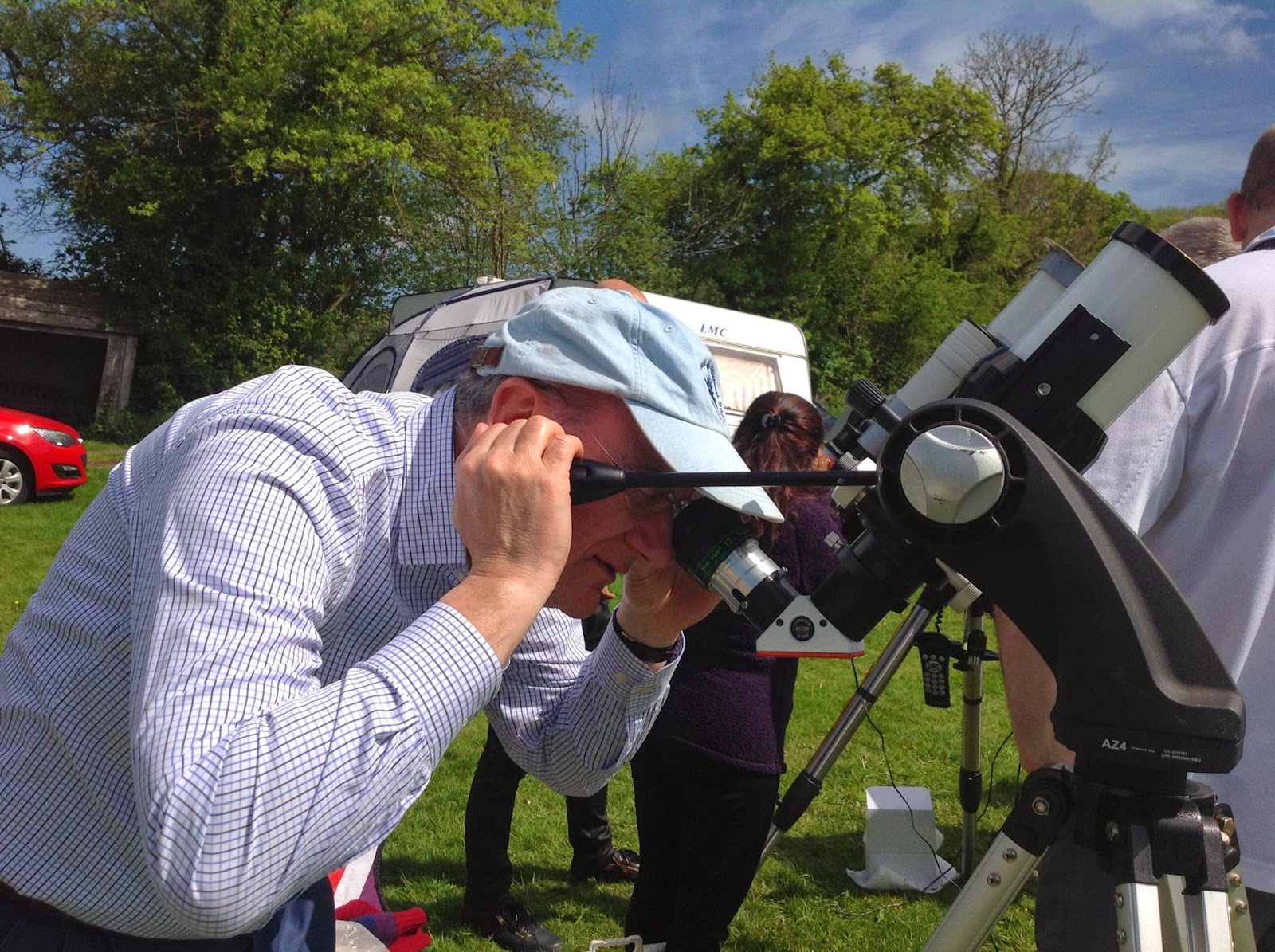
Having ‘pegged my claim’ on the Common with my groundsheet I set up my equipment: for solar observing, my Lunt 60mm single stack with pressure tuner and B1200 blocking filter mounted on my AZ4 Alt-Az mount. This set up is entirely manual: no computer control, no alignment so I was able to set up and observe the chromosphere of the Sun within a few minutes.

photo by Fawzia Muradali Kane

For the dark nights I had planned to observe a few of the DSOs not visible in central London, particularly galaxies and had my eye on seeing M108, the elliptical galaxy in UMa which I had yet to view. At mag 10.7 it was a possible target at Cwmdu. I brought my trusted 3” refractor, the William Optics GT81, transported snugly in its own rigid backpack. I also set up my cheap SynScan Alt-Az GoTo mount and tripod, too lightweight to carry heavy scopes but sufficient to take the Lunt or GT81 if I wished to track any target.

In the Saturday late afternoon daylight I spent time observing in H-alpha the complex sunspot group making up AR2339. Not the best time of day for solar observing: I prefer the morning when the air is less turbulent. The group was a complex set of spots and observing them proved to be my highlight of the star-party.

Image by Dave Wilkinson

After dinner in the pub I viewed the evening skies: a light haze shrouded Venus and Jupiter as they appeared then only a few small patches of clear areas were spotted. During a frustrating session spent staring at low cloud I did manage to spend three quarters of an hour observing galaxies M81 and M82, globular cluster M92 and Saturn as it rose in the east, yet in the little time available M108 still eluded me. The clouds defeated me: I gave up and covered my scope at 01:30, walked to the pub and was in my room above the pub, my ‘Presidential Suite’, by 02:15.

Each Sunday morning of AstroCamp I host a solar observing and imaging session on the Common, from 10:00 until noon. But looking out of the pub windows while consuming my  generous cooked breakfast it was obvious the low grey cloud cover would prevent any solar observing that Sunday. So a gentle walk in neighbouring country lanes was the order of the early morning and I was pleased to be rewarded by hearing the call of a Cwmdu cuckoo. The rest of morning was spent in astro-talk and socialising with old and new AstroCampers. One topic of conversation I introduced was the current UK market for astronomers. How many amateur astronomers buying equipment are in the UK? And how much do they spend on a regular basis?

My neighbours on the Common formed an ad hoc team to compete in the astro-quizzes arranged for that afternoon at the nearby village hall. After much gentle ragging from the quiz organisers we triumphed in the ‘Masters of the Universe’ advanced astro quiz winning a box of bottled of beer. In the late afternoon and evening it was obvious the chances of clear dark skies that night were slim. But I remained on the Common staring at clouds until 01:30 when I repaired to warm bed.

The sun was out on the third morning and good solar observing was had by many on the Common. White filters over objectives, hydrogen alpha Lunt and Coronado ‘scopes and Daystar Quark filters were put to good use to observe and record that interesting multiple sunspot group AR2339. I did witness a degree of flaring at a couple of places between the spots at each side of the group. In addition a prominence on the following solar limb developed beautifully throughout the morning. I did enjoy showing the chromosphere features to those who had never viewed through a H-alpha ‘scope before.

photo by John Liggins

I broke off my viewing for the traditional communal High Tea on the Common which is held at the early time of 2pm. Everyone attends and contributes a little food and drink to this well established AstroCamp event. I quitted observing the Sun soon after the Tea to take exercise walking in Cwmdu lanes as clouds again arrived to ruin prospects of any dark skies on the last night. On the Common we persisted in hoping for gaps in the low  clouds to appear but for hours were frustrated: I can claim we present on the Common did see Venus with our unaided eyes. Such was our frustration with the clouds that we cheered whenever the planet popped into view for less than a minute as it set behind the western hills. At midnight I walked back to the pub and my bed.


The arrival of early dew during a night session had been a problem at past AstroCamps. At the previous meeting last September a session under clear night skies had been cut short for me by dripping moisture appearing on the objective, eyepieces and red dot finder of my 81mm refractor. Application of gentle heat from a neighbour’s camping hairdryer only removed the moisture for a short time: the dew quickly reappeared making further observing impossible. This time, in anticipation of Cwmdu dew, I had purchased a Kendrick dew controller and suitable heat band. Not needed at my sessions in the Canaries, the system was to be debuted at AstroCamp yet still unused.

On the Tuesday morning, collecting my kit from the Common, I said my farewells and motored back to Marylebone. I shall return to Cwmdu next September

2014-07-18

Central London SUNday - 2014 June 22


In late June last year I arranged an informal, fun-filled day for a group of fellow London amateur astronomers to observe the Sun with white light filters and hydrogen alpha solar telescopes in a London park and have a picnic. The day of the week I chose was, of course, a SUNday! It was a great success so I decided to repeat a similar solar observing day this Summer on Sunday June 22 as this date coincided with the first International SUNday.

Living in Central London I wanted the event to be held nearby so I named it the Central London SUN-day and decided again to hold it in Regent's Park, one of my favourite London green open space.

I invited my fellow Baker Street Irregular Astronomers to the day, as well as others through my FaceBook group 

I had mentioned my planned event to Tori Weaver, a BBCTV Sky At Night researcher, I met at the Brecon Beacon AstroCamp and later I was delighted to hear she had organised a TV crew and Pete Lawrence to attend my SUNday to film part of their July programme devoted to daytime astronomy and the brightest star. The four minute clip from the Sky At Night July programme is on their website.

The weather in London just prior to the SUNday was fine and warm and I had managed several enjoyable morning solar observing sessions with my Lunt LS60THa so I was delighted the Sun shone early on the SUnday morning. 

Approximately fifty turned up for the day with about a score of solar scopes and adapted binoculars.
Photo  by Eric Emms

Photo  by Eric Emms

Photo  by Eric Emms


The curious public were shown the Sun through white light and hydrogen alpha filters, picnics were consumed, astronomy (solar and other) was discussed and explained, many photos were taken and fun with a little solar education was had by all.

I shall be holding the next Central London SUN-day, again in Regent's Park, on 2015 June 21. I hope to see you there!


2014-07-10

Canaries - first trip in 2014

Leaving the William Optics GT81 refractor and Lunt60THa solarscope back home in Central London (soon after their successful appearances at my Central London SUN-day solar observing and picnic in Regent’s Park) I took to the air and was soon reunited with my APM 100/800 LZOS refractor I keep caged in the Canaries. 

Photo by Raquel Chavez Garcia
The main idea for this trip was to observe a few more DSOs around the MW, particularly in the Scorpius and Sagittarius constellations. Of course, the Milky Way refuses to show itself in Central London, and at both 2014 astro-camps I’ve attended in Cwmdu, Brecon Beacons and Brighstone, Isle of Wight, the MW is not as glorious to view as in the southern latitudes of the Spanish islands off Morocco.

My APM was soon thrown on to my HEQ5Pro mount, also kept in the Canaries, and observing was had most nights of my ten day trip. I’m not much of an astro-photographer, granted I’ve uploaded a few lunar and solar snaps to my Flickr site in the past, but I much prefer photons from extraterrestrial objects on my retina not a CCD chip. The dark (very dark) skies experienced at my observing site above the clouds, dust and light at 2,300m thus were exploited as much as possible.

I had a list of DSO targets I wished to observe during my sessions; some of these were ones I had yet to view while the remainder were old favourites such as the Lagoon and Trifid nebulae.  I do enjoy seeing clusters, both globular and open, and it is a Canaries tradition for me to become reacquainted on my first night with that monster globular low in the south, invisible from the UK, Omega Centauri. I ogled it every night with both the APM and with binoculars and never tire of its beauty and size.  I was delighted that I did observe all I had wanted to see and was able to show some celestial favourites to a small group of friends and family on the volcano. 

Photo by Frank Kaemmerer
Saturn (admittedly past its best) seen by friends for the first time and the waxing Moon prior to setting early in later sessions were much admired by all.

Photo by Eric Emms
For the first time during my Canaries trip I was asked by a nearby hotel to bring my telescope to their attractive grounds to show a few celestial gems to a small number of their guests. 

Photo by Frank Kaemmerer
Feedback from all was positive so I shall be repeating an hotel ‘star-party’ when I return to the islands later in the year.


2014-05-16

Jupiter: triple moon shadow transit


With my small refractor (WO GT-81) I enjoy observing Jupiter: its belts, zones, the GRS (the latter always looks a lighter grey to my retina) and the four Galilean moons. I've seen a few single and double transits of moons and shadows from my terrace in Central London ('EmmsTowers'). At the April AstroCamp in the Brecons, Wales I had fun observing a transit of Ganymede on Jupiter in clear BLUE skies through a friend's 16" bespoke Dobsonian - a first for me.

So when I learnt there will be a rare triple shadow transit occurring on June 03 beginning in daylight I was determined to have a crack at observing as much as can with my 'frac. At the critical time in the afternoon Jupiter will be in the western skies, a part of the heavens obscured by buildings at EmmsTowers so I've arranged for a few friends to join me to observe the event from Regent's Park.

 It will be fun to find Jupiter in blue skies and see what is on view.

AstroCamp Apr 2014

I'm always keen to attend AstroCamp held biannually in the dark skies of Brecon Beacons National Park, Wales. Being an urban stargazing I love to get under darker skies, whether of the Canaries, Isle of Wight and the Brecons.

Last month I attended the latest AstroCamp with the expectations of three dark nights around the April New Moon. The weather, always changeable in the UK, didn't cooperate, providing plenty of rain and cloud. But I did manage a few hours observing with my WO GT81 of a few DSOs I cannot perceive in Central London, namely a trio of galaxies in the Virgo galaxy 'realm' new to my retina, M49, M87 and M60.

During daylight hours I spent the few cloud free hours doing a spot of solar observing


Upper pic by Carol Grayson. Centre pic by Howard Cooper. Lower pic from BBC iPlayer

and demonstrating chromospheric features to others with my Lunt60HaT. Part of the May 2014 Sky At Night television programme was filmed at AstroCamp. The last photo is a brief shot from the show.

The next AstroCamp will be held September 20-23.

2014-04-12

Jodrell Bank Telescope

2014Apr03 by Eric Emms

I visited Jodrell Bank as a member of a group organised by Friends of the Royal Astronomical Society, to see the famous Lovell Telescope, hear a talk from the Director Prof Simon Garrington and visit the Control Room of the observatory.

The dominant feature of The Jodrell Bank Observatory is of course the radio telescope, one of the world’s largest, known as the Lovell telescope


Walking up close to the telescope one is struck by its sheer size and the beauty of its design.


Notices scattered along the footpath tell you to switch off your mobile phones as signals would interfere with the radio signals collected and relate simple facts about the work of the telescope. 

The  Discovery Centre which receives thousands of visitors is home to exhibits and visual presentations describing basic astronomical concepts.

Prof Garrington’s illustrated talk described the present set-up of the observatory, its early work and its current importance as the organisational ‘hub’ of present national array of radio telescopes across England (e-Merlin) and in the future international radio astronomical research (SKA)

The conclusion of our trip was a visit to the Control Room, where the BBC Stargazing Live TV programme is filmed. A brief illustrated talk by a resident radio- astronomer explained how radio signal data collected at the observatory are processed to produce a meaningful image of the target radio source to resolutions in the order of microarcseconds, as good as or better than the resolution seen in Hubble optical images.

Thanks to Marcus Hope of Friends of the RAS  for organising the trip.

2014-01-17

Astronomy and Me: How I Started...Stopped...and Restarted.

It started for me with Apollo 8 and Patrick Moore.


Christmas 1968: your pre-teen author watching the BBC coverage of Apollo 8. On the screen was this strange looking man talking rapidly explaining why the mission was so important.


His words, still potent when seen and heard today, helped arouse the child’s interest in space and astronomy. I collected newspaper cuttings of the Apollo missions, glued them into a long-lost scrapbook and devoured all the astronomy books available from my local library, many written by Patrick. I well remember reading his 5th edition of Amateur Astronomy.

My parents encouraged my interest: the first astronomy book I owned, received as Christmas present in late 1960s was Larousse Encyclopedia of Astronomy, a paperback edition in 1966. It was, effectively, a text-book of what was known in the mid 1960s, with emphasis on the Moon, planets and stellar composition.


I received another present from my parents, a small telescope with a table tripod: a cheap refractor. A toy in essence, but through it I could enjoy for the first time the splendour of the craters of the Moon; Saturn and its rings; and Jupiter and its moons.  A toy microscope was also purchased for me. Both presents and other educational toys triggered a life-long interest in sciences (little did the boy realise he would later spend a third a century looking at diamonds and precious stones through a rather different microscope: but that’s another story).

But I can’t recall watching the Sky at Night on a regular basis and as the public awareness of the Apollo programme diminished so did my curiosity in astronomy. ‘O’-levels, three science ‘A’-levels and an honours degree at King’s, London passed without much thoughts of astronomy. A subsequent career with precious stones in Hatton Garden, London eclipsed any interest I had for the heavens – perhaps I was too preoccupied with gems to bother with stars.

However the embers of astronomical interest smouldered occasionally; I recall staring at the many large (to me) telescopes seen through the large window of Telescope House in Farringdon Road, close to Hatton Garden, and casual glances at the Sky This Month diagrams and notes published monthly in national newspapers but certainly no observing since the time of the now long abandoned toy ‘scope. But I do remember being impressed by comet Hale-Bopp seen with my naked eyes hanging in the heavens when on business trip to Basel in April 1997 and explaining what a comet is to Swiss contacts.

After moving to Marylebone in the late 1990s, I would walk past a shop off Baker Street, 


glimpsing telescopes in the window and form a fancy of buying a ‘scope in the future for the time, if and when, I retired abroad. Little did I know then...

Perhaps you, too, do not think you share the so-called ‘passion’ evident in the amateurs you read about on-line, meet at astro-events or follow on social media. Take heart, a greater interest in astronomy can be reignited. For me, it happened on a walk in April 2011 when a curious incident in Regent’s Park occurred - I saw a poster on a notice-board.


On the spot, I decided to investigate...

2013-10-20

Penumbral Lunar Eclipse 2013 Oct 18.

by Eric Emms

The Flamsteed Astronomy Society had organised a meeting on Blackheath to observe the eclipse and the Sky At Night TV programme  planned to film the event for transmission in early November. Several Baker Street Irregulars,  including me, would be attending.

I arrived at the location by car before 19:00 UT to find bright lights from the TV crew illuminating the patch of the heath where an array of telescopes had been set up. In the light it was easy to set up my William Optics GT-81 then ponder the thick clouds masking the Moon.

Photo: Julie Ramsden.

The four-hour eclipse was expected to be at its maximum at 23:51 UT so all had time to chat with the Flamsteed astros, Irregulars and curious locals who turned up to see the event.

Photo: Philip Stobbart

We waited for the clouds to part. We waited. The TV hosts went through their routines to camera. We waited. Lunar and asteroid belt meteorites were thoughtfully shown to us by planetary scientist Katie Joy 

Photo: Philip Stobbart

Then we waited and chatted. And we chatted and waited. The Moon poked through the clouds on occasions allowing me to show the disc to a few young people but soon retreated behind cloud cover.

As the hours of the eclipse wore on there was little chance of observing any of it. The astronomer numbers were draining away: I packed up, thanked the Flamsteed organisers, trudged to my car and headed home.

2013-10-16

I Have Never Seen Mercury


Since I’ve taken up stargazing again in 2010 the opportunity to see Mercury, that sun-hugging innermost planet, has never arose. In other words I have never seen Mercury, truly a confession any stargazer should be ashamed of.

My Central London observing site (my terrace at my home) provides a good Eastern facing aspect but objects low in the Western sky are obscured by houses. Mercury and other planets close to the setting sun are beyond my reach.

The triple conjunction of Jupiter, Venus and Mercury in late May 2013, when all three planets were within 5 degrees of each other soon after sunset, provoked me to attempt to see Mercury for the first time.


Credit: Chris Schur.

Could I find a near-by site to view a western horizon within Central London with my telescope? No. And as I didn’t wish to travel outside town I decided to go Mercury hunting in London street armed with my binoculars, an old East German Carl Zeiss 10x50 pair.

On the evening of the 27th May I walked to a suitable vantage spot in a Central London street and waited on a pavement for dusk and the appearance of the triplet. The spot turned out not to be sufficiently suitable: no planets were seen, buildings still hindered my view. I tried again the following evening in another street – another failure. There are too many buildings in London. I did succeed in receiving suspicious glances from passers-by who must have wondered why I was peering through binoculars, one community support office (a traffic warden) ending his shift engaged me in conversation demanding to know what I was up to.

Mercury had to wait until my first 2013 trip to the Canaries planned for June. Meanwhile I resolved never to attempt again on-street observing.


2013-07-02

Solar observing at AstroPicnic 2013

The idea for a day of observing the Sun through solar filters and having a picnic arose from a discussion I had in May with Fawzia Muradali Kane, a fellow Irregular of the Baker Street Astronomers.

I decided that the best date for the first of its kind would be Sunday 30th June. Floating the suggestion on various social media gathered a sufficient positive response so all was set. We just needed clear skies and a suitable site. Following our tradition of meeting in Regent’s Park for our regular BSIA events it seemed natural to hold the solar viewing with the park. It was suggested that close to the amenities around Hanover Gate would be the best location.

The day before the event I had my last recce of the spot; it looked quite deserted at noon and offering ample opportunity to track the sun as it moved across the sky from morning to late afternoon. No trees would impede any observation.

The weather for the planned day looked promising: warm temperatures with light variable clouds and at 09:30 on the Sunday I picked up my kit and walked from home to Hanover Gate, Regent’s Park and was delighted to find the spot was deserted. 


I set up my 81 mm refractor with its Baader solar film filter on its dew shield and being obvious in an otherwise deserted field soon attracted the curious attention of early morning dog walkers, joggers and the regular patrol of an armed policeman. I began observing at 24x three obvious active regions; AR11777, 1778, and 1781.

Soon other Irregulars joined me, pitching their dedicated hydrogen-alpha Lunt solar ‘scopes, telescopes sporting white light solar filters and tripod mounted binoculars. Pretty quickly a score of us were observing our closest star and showing interested passers-by their first view of sunspots.


The day progressed by comparing the view seen through the two Lunt solar scopes kindly brought my Chris and Simon with those seen through white light solar filters, chatting to friends old and new about astro and non-astro subjects; snacking on our picnic victuals.Through the H-alpha filters of the Lunts we saw spectacular examples of prominences, filaments and plages


The temperatures soared to 26°C tempting many to the park so by 3pm we were surrounded by a collection of picnickers, sunbathers, footballers determined to strike a telescope with a ball, energetic young children running around and one kite-flier, so it was time to declare the day a success, break down our equipment pack up our bags and head home.

My thanks go to all who attended particularly those who brought the scopes and binoculars. We shall return for another AstroPicnic in Regent's Park next Summer.


2013-05-24


AstroCamp May 2013.


This was the second AstroCamp at Cwmdu campsite in the Brecon Beacons organised by the Baker Street Irregular Astronomers and as the skies and weather were superb for the first event in Sep 2012 I was keen to attend the latest one. I prefer observing with my eyeballs to imaging so I brought along a ‘shopping list’ of DSO targets to observe over the long week-end. I booked an off-site ticket as soon as the event was organised; I do not camp so, as before, I reserved a room at the local pub, The Farmers Arms.

Friday, 3rd May.


I, with two other Irregulars car sharing, arrived following a four-hour car trip from Marylebone, to find the campsite filling with Astros and their kit expectant of fine clear night-time skies. There was time in the afternoon to set up the WO GT-81 on the AZ4
and contemplate some sunspot viewing using my hand made solar film filter. Less than a minute of viewing elapsed before the clouds enveloped the Sun to remain all evening and night.


Saturday, 4th May.

It had rained during the night and the morning was grey and damp. But there was soon time for some morning solar viewing as the skies cleared.

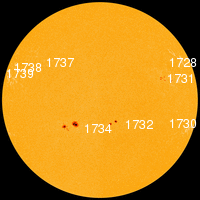
pic fom Spaceweather.com
Active regions 11728 to 11739 were observed through a Baader Astro SolarFilm filter at x48 (20mm Vixen NLV EP in a Celestron 2x Barlow).  AR11734 displayed an interesting cat’s paw shape.


At 3pm it was time for the Astro Pub Quiz in the pub where my current lack of astronomical knowledge was demonstrated once again! By 6pm we were back in the camp field viewing Jupiter in the western blue skies until Saturn rose in the East. After observing the two planets easily seen from home in Marylebone I was keen to view a celestial object not visible in the light polluted skies of Central London.  For 2.5 hrs I observed a longed for target: the Leo Triplet.
Leo Triplet - pic from Wikipedia
 I’ve never observed them from London so I was determined to enjoy them in the dark skies of the Brecon Beacons. M65 and M66 were delightful fuzzy ovals but NGC 3628 eluded my eyes.  By 11:30 clouds had arrived and so to bed satisfied with observing two Messiers unseen by me before.


Sunday, 5th May.

The skies were extremely clear as my evening observing session started at 21:30 UT. I started on my list of DSOs I can’t see from Central London. First up was M51, the Whirlpool Galaxy.

M51 - pic from NASA

I located it using my manual setting circles on my AZ4 mount from co-ordinates provided on my SkiSafari Pro app. At x24 I could detect a rounded even silvery shape – of course nothing like the detail seen in the image. I was pleased the evening started successfully.


22:09 UT - Next up was the Bodes galaxies, M81 and M82. Again I’ve tried several times unsuccessfully to discern these in London and was excited when both hove into view appearing as milky ovals at 24x.

M81 and M82. Image from astrobin.com


21:32 UT – many fellow Astros were enjoying the Great Globular Cluster in Hercules, M13, so I joined in with the excitement and pointed the GT-81 at it and was pleased with the far greater detail than when viewed from NW1.

M13. Image by NASA


21:43 UT – I returned my attention and scope toward the Leo Triplet. As during the previous evening not all three were observed at x24 but the two Messiers: M65 and M66. The faintest NGC 3628 was again a ‘no show’ to my curious eyes. The two oval smudges were a delight to register. I felt my trip to the dark sky site had been worthwhile just to see these.

Finally I returned to globular clusters and spent time enjoying M53 at x24.

M53 pic from messier.seds.org


I was pretty tired by 21:45 UT so decided to relax in one of my astro-chairs with my 10x50 binoculars scanning the Realm of Galaxies in Virgo. Dew arrived presently on oculars and objectives hampering further observing by telescopes and I called it a night just before midnight.

Conclusion.

I went to Brecon Beacons for the dark skies, to observe DSOs I cannot detect from Central London. I was delighted and excited to see all I wanted to see in the skies. My experience has whetted my appetite for the Canary Islands skies I shall be under in early June.


2013-05-23

Baker Street Irregulars Astronomers - May 20133 Meeting

Photo by @jimanning. 

By Eric Emms.

For this month's meeting I wanted to view the triple planetary near-grouping of Jupiter, Venus and, the planet I've yet to observe, Mercury. 
The trio were to be seen low in the north-west soon after sunset due at 19:56 UT. (8.56 pm BST). I arrived at the Hub, Regent's Park earlier than sunset so spent time observing and showing to others sunspot activity using my solar film filter.

The Moon, waxing gibbous, 9/10th illuminated, soon revealed itself from behind light cloud in the East and as the Sun became obscured by the trees of the park I showed the Moon to a few first-time visitors to our group. Against a bright sky little definition of the lunar surface could be made out at that early part of the evening.

Soon I spied Jupiter through my 10x50 binoculars, bright but very low in the north-east. Through my WO GT-81 at 48x the planet showed as a small bright disc although no Galilean moons were detected. Both Venus and Mercury escaped my scrutiny and Jupiter, now eye-visible, soon sank below the tree-line. A few first-timers at the Hub observed Jove for the first time: not its best display, of course, but Saturn awaited.

Turning to the east, my binoculars again helped as I located Saturn in a still blue sky, a few degrees left of the brightening Moon. Seeing conditions suffered during the evening: poorly defined cloud belts on the disc could be glimpsed but satellites weren't seen. The rings, as always, delighted those present who observed at 48x and 224x.
All other photos by @PhilipStobbart


I returned to showing to others the bright Moon


But it was now so dazzling observing at the eyepiece had become painful on the eye. I didn’t bother to crack open by variable polarizing filter so I decided to try something new. I projected the Moon's image from the eyepiece on to paper to the delight of all around.


As the stars finally made their appearance I turned my scope toward the zenith 


to show the multiple stars of the binary Mizar and Alcor.

Finally I awaited the appearance of a bright Iridium flare in Leo before heading home.